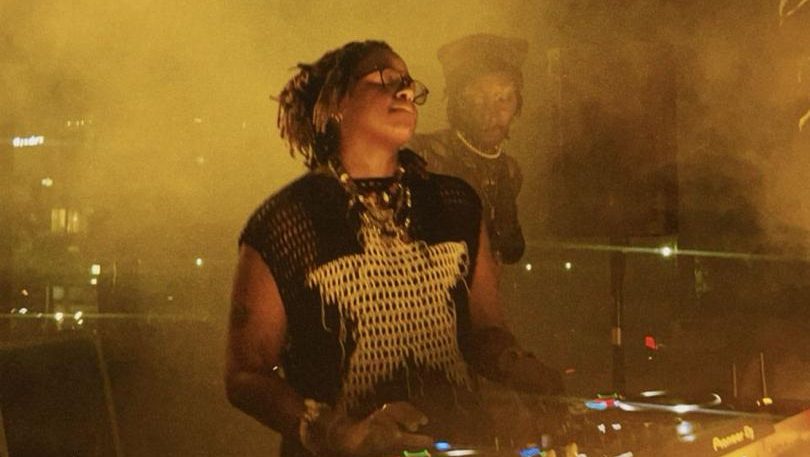
Abiodun has emerged as a cultural outlier. He is a man of many skins: a former lawyer, a singer once known for soulful lo-fi leanings as a solo artist and as part of the duo Miles from Mars, and now, the visionary creative director and DJ at the heart of an electronic renaissance. There is a definite warmth to his presence, a quiet but contagious excitement about what he’s done, doing, and planning to do.
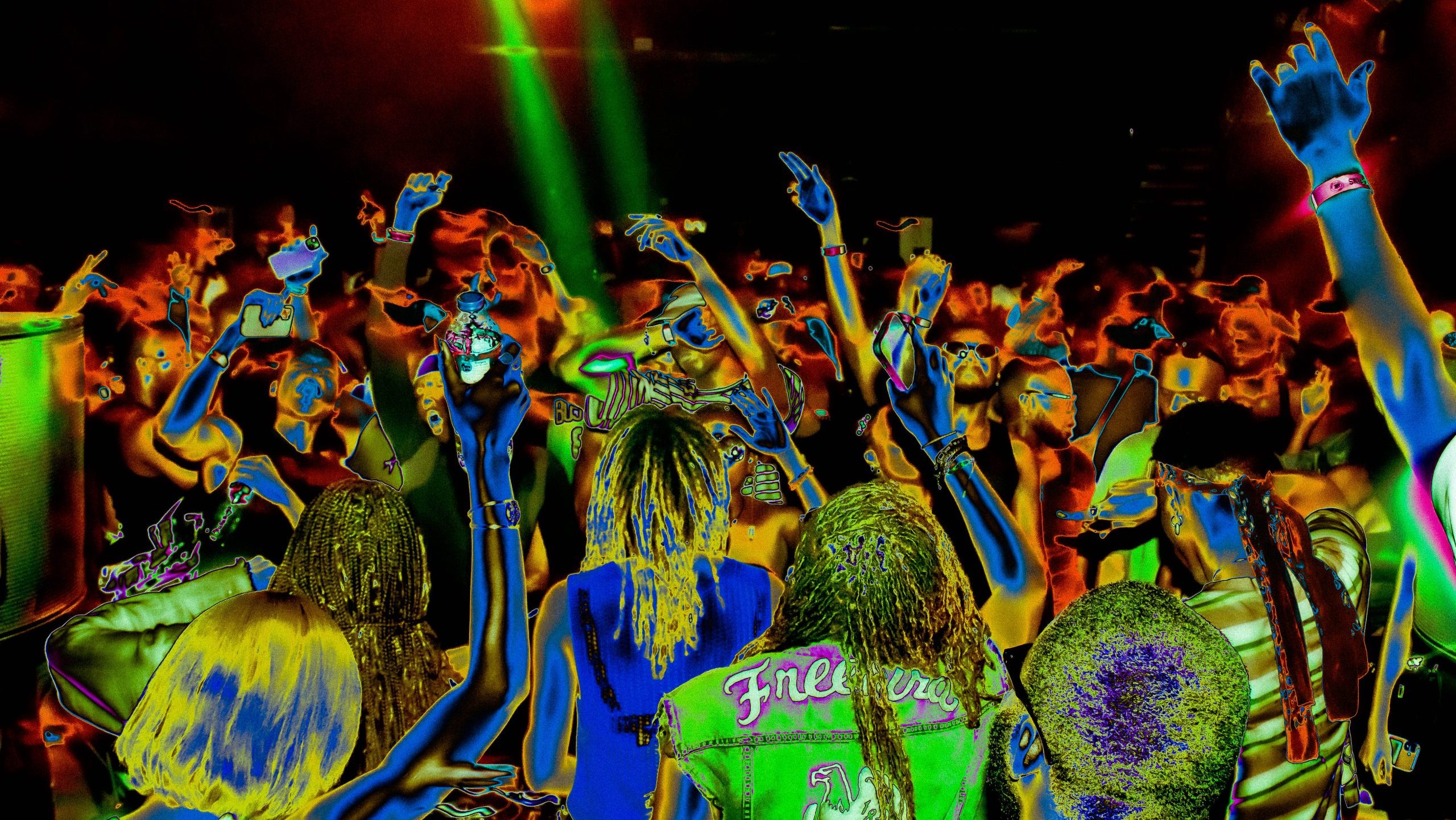
At the centre of his world sits Ilé Ijó. The name Ilé Ijó translates literally from Yoruba as “house of dance,” but it has come to mean something more layered than that. It started in 2023 as Miliki, a name that had to be quietly retired due to intellectual property issues, and was relaunched as Ilé Ijó in February 2024. In less than two years, it has grown into one of the most talked-about collectives in the Lagos electronic scene. Pulse Nigeria described it as “a rare example of a party that functions as both a dancefloor and an art installation.” TechCabal called it “a haven for people who like raves with smaller, more controlled crowds and fusion sounds.” In November 2025, Ilé Ijó was invited to represent Nigeria as a collective at Nyege Nyege’s 10th anniversary edition at Kalagala Falls in Uganda, sharing the bill with over 300 artists, including Skrillex, Flowdan, and the Singeli Movement. Alongside it on the Nigerian delegation was Group Therapy, another collective that has come to define what the Lagos rave scene looks like at its best.
And alongside all of that, there was Boiler Room. In December 2025, his other project Club Àlùjó won Boiler Room’s Broadcast Lab competition, earning a live session on one of the most globally respected music platforms. The concept was bold by any standard: a bold reimagining of Fuji music in a club context, blending emerging live Fuji acts with DJs pushing the genre into new territory. Fuji, which emerged from Wéré vocal prayer chants in Muslim Yoruba communities in the 1960s, had never quite been placed in this context before. But for Abiodun, it made complete sense. “The core of it,” he says, “is how do we ensure this sound continues to live on.” When asked what he thinks a Fuji vanguard like Pasuma or KWAM1 would feel about what he’s doing with the sound, he says, “I feel like they’d be really impressed with the direction and the expression of the idea. Because once that generation is gone, God forbid, there’s really no one holding the mantle in the same way. I’d hate for it to be a genre that just lives for fifty years and then dies off.”
This is the kind of thinking that runs through everything Abiodun builds. He started DJing in 2023, learning in April and playing his first live set in September of the same year at an anniversary party for a friend. He then played Insert Nights, had his own show called Melt by December, and launched Miliki, which became Ilé Ijó, by February 2024. The speed of that trajectory is striking, but Abiodun is careful not to make too much of it. “I just think of myself as someone who likes to dig deeper,” he says. “The intention that drives what we do is just putting people on to music they can trust.”
That intention is visible in every edition of Ilé Ijó. Each one is built around a central theme that runs through the music, the decor, and the promotional assets. In March 2025, an edition called Venus celebrated divine femininity through an all-female lineup featuring Aniko, 3FIA, WeAreAllChemicals, Earthsurfin, and Ayo Fawo. Abiodun handles most of the creative design himself, going back and forth with his designer until it reaches what he sees in his head. “I believe good design is everything,” he says. “If you’re able to put out good design, people are drawn to it, and they want to be part of what you’re creating.”
But the transition from a vision in Abiodun’s head to a functioning dancefloor is rarely a smooth one. For all the talk of intentional planning and meticulous design, the reality of event production in Lagos is often a battle against unseen forces. Every event, he admits, comes with the feeling that it might all fall apart. “The one I can remember most clearly was in December,” he says, recalling a high-stakes show. The vendors were late, the equipment was wrong, and the lights were failing. Then came the climax of the chaos: “When everything was finally ready, we went to plug in and test it, and the DJ decks literally caught on fire.” It was 6:00 PM. The show was set to start at 9:00 PM. “Sometimes, you just wonder who sent you to do this.”
The events alternate bi-monthly between the main Ilé Ijó edition and Ilé Ijó DnB, the drum and bass variant hosted by resident DJ Marina Rd Sound, which pushes the crowd well past 160 BPM and draws a devoted subset of Lagos listeners who have been waiting for the city to catch up with their sound. The drum and bass (DnB) instinct is personal. Abiodun first encountered the genre in secondary school while digging through foreign music, rediscovered it when he met Marina, and built the concept for having a DnB music vertical together with him. He is straightforward about what drew him to it. “If it sounds good, people are going to dance. It really doesn’t matter what BPM you’re playing.” He is equally direct about what Ilé Ijó represents. The bottle service culture, the VIP sections, the transactional energy of much of Lagos nightlife; none of it belongs here. “A rave is meant to be a place where everyone from all walks of life comes to dance,” he says. “Everyone on the same dancefloor, standing in front of the DJ, beside the DJ. That helps with the communal feeling.” He once used the phrase “dissolution of sophistication” to describe this, the idea that everyone should leave their social performance at the door before they come in. While certain individuals have very big feelings about what can be termed a “rave” as opposed to a generic party, Abiodun is hesitant to play the role of the genre’s police. To him, the distinction isn’t found in a checklist, but in the energy of the room. “I really don’t like to have strong opinions on what people call their event,” he says. “But what I know is people can tell what is and what isn’t.” And what’s the vibe? “If Ilé Ijó were a person at a party, they’d be sexy,” he says, playfulness breaking through his calm. “Very forward-thinking, very free, very accommodating. The kind of person everyone wants to be around.”
Inclusivity is not a buzzword at Ilé Ijó. It is a designed principle. “For example, it’s a place for everybody, including homosexual people, to come and express themselves,” he says plainly, in a country where that kind of openness is not without risk. “It’s a place where people come in all kinds of ways. This radical inclusivity is a lived reality on his dancefloors. He recalls a recent show in Ghana where the demographic shifted in a way that most youth-led events rarely do. “A much older woman, probably in her sixties, came and was dancing with everyone,” he shares. To Abiodun, this is the ultimate proof of concept: that if the music is right and the environment is safe, the barriers of age, orientation and class will simply evaporate. “The only requirement is that you like the music and you’re a decent human being. As long as you respect other people and don’t harass anybody, you’re welcome.” The language used in marketing, he says, is chosen deliberately to make that clear before anyone even walks through the door.
Ilé Ijó is far from the only rave you’d find on a Lagos event calendar on any given weekend. The city’s electronic scene is blossoming right now. So, what does it feel like existing in the same sonic territory as other heavyweights like Monochroma, Sunday Service, Element House and others? Abiodun is refreshingly honest about the friction inherent in any creative boom. He acknowledges that in a space where everyone is vying for the same ears, a natural tension exists. “In any space where two people are doing the same thing, there’s going to be some competition,” he admits. “Sometimes you see an idea, and you think, ‘I wish I had thought of that,’ but it’s never from a bad place. It’s never ‘I hope you fail.’ I’m mostly competing with myself, trying to outdo the last edition.”
Abiodun came to all of this from a different place. He was a law student. He was a singer. You may know him from his singles like .indigo (released under the moniker Bio), or from his releases as part of the duo Miles from Mars with Soulblacksheep. He doesn’t talk about those chapters as failures or detours; they just were. He is not even fully comfortable saying he is pursuing music now. “I’m just doing things I like and seeing where they go,” he says. He grew up surrounded by Fuji music and Islamic songs in a very traditional Yoruba household, found hip-hop on his own, moved through afrobeats, and arrived at electronic music through curiosity and a desire to introduce people to sounds they wouldn’t have found without him. He stopped being religious about five years ago, a fact he offers without drama, in the same quiet, unhurried way he offers most things.
The unhurried quality is deceptive. There is a lot happening. Bring Your Own USB, an initiative under the Ilé Ijó umbrella designed to give emerging DJs access to stages they would not otherwise reach, is being expanded in 2026. Red Light Fashion Room, a separate project based mostly in Ibadan, was one of the first platforms to give him a stage to play House when the nights out only welcomed afrobeats. Club Àlùjó, now Boiler Room-validated, is building its own distinct world at the intersection of Fuji and club culture. And somewhere in the background of all of it, Abiodun is learning to make beats and teaching himself piano. “I’m trying to relaunch my artist career as a producer this year,” he says, almost as an aside.
When the Lagos electronic renaissance is eventually documented, his name will appear in several chapters at once. He seems aware of this, even if he is still figuring out exactly what he wants it to mean. “I would like to be remembered as one of the very few people who were not afraid to do things differently,” he says. “The person who was at the forefront of wanting to do new stuff. In terms of design, in terms of how we communicate our ideas, in terms of how we curate the parties. I want to be remembered as one of those guys that, in my days, liked to do things differently and just carve out a lane for himself.”
It is a measured answer, characteristically so. But the path is already there. He’s walking it.