Every year, two days after Ileya, something extraordinary happens in a town that most Nigerians couldn’t point to on a map without help. The streets of Ijebu-Ode fill up. Horses gleam under the Ogun State sun. Fabrics so fine they look painted catch the light. And somewhere in that crowd, among thousands of people who have been doing this, or something like it, for well over a century, a man rides in on a decorated horse and breaks the internet.
Ojude Oba is one of Nigeria’s oldest, deepest, most structurally elaborate cultural festivals. It is also, right now, one of its most viral. Those two things are not in contradiction. But they do raise questions worth sitting with.
The standard origin story goes like this: in the late 1800s, under Awujale Ademuyewo Afidipotemole, Islam was spreading through Ijebu-Ode. When Christian missionaries arrived and baptised converts, each man was expected to give up all but one wife. Chief Balogun Kuku, one of Ijebu’s wealthiest and most influential men, looked at that condition and chose Islam instead. His conversion was so high-profile that it pulled others with it.
During one particular Odeda Festival, a celebration tied to indigenous religion, Balogun Kuku led a large, lavishly dressed procession of his sons, followers, singers and drummers to the Awujale’s palace to pay respects. The traditional worshippers already gathered there scattered when they saw the crowd approaching, some fearing that war had arrived. Odeda never recovered. In its place, Ita-Oba (“Forecourt of the King”) was born: an annual act of homage by Muslim converts to their monarch, expressing gratitude for being permitted to practice their faith freely. It was later renamed Ojude Oba under Oba Sikiru Kayode Adetona, who ascended the throne in 1960 and formalised and modernised much of what we recognise today.
There is, however, a more layered reading. A cultural commentator has argued that the festival, in its current format, is over three hundred years old, and that the egbe (age-grade) system existed long before the 19th century, with the word “regberegbe” coined by Oba Adetona himself to rebrand an ancient institution. Both accounts can be true: the Islamic thanksgiving origin is real, but it was absorbed into a much older framework of communal gathering and royal homage. The festival we celebrate today is a synthesis, which is, incidentally, also the story of Ijebu culture itself.
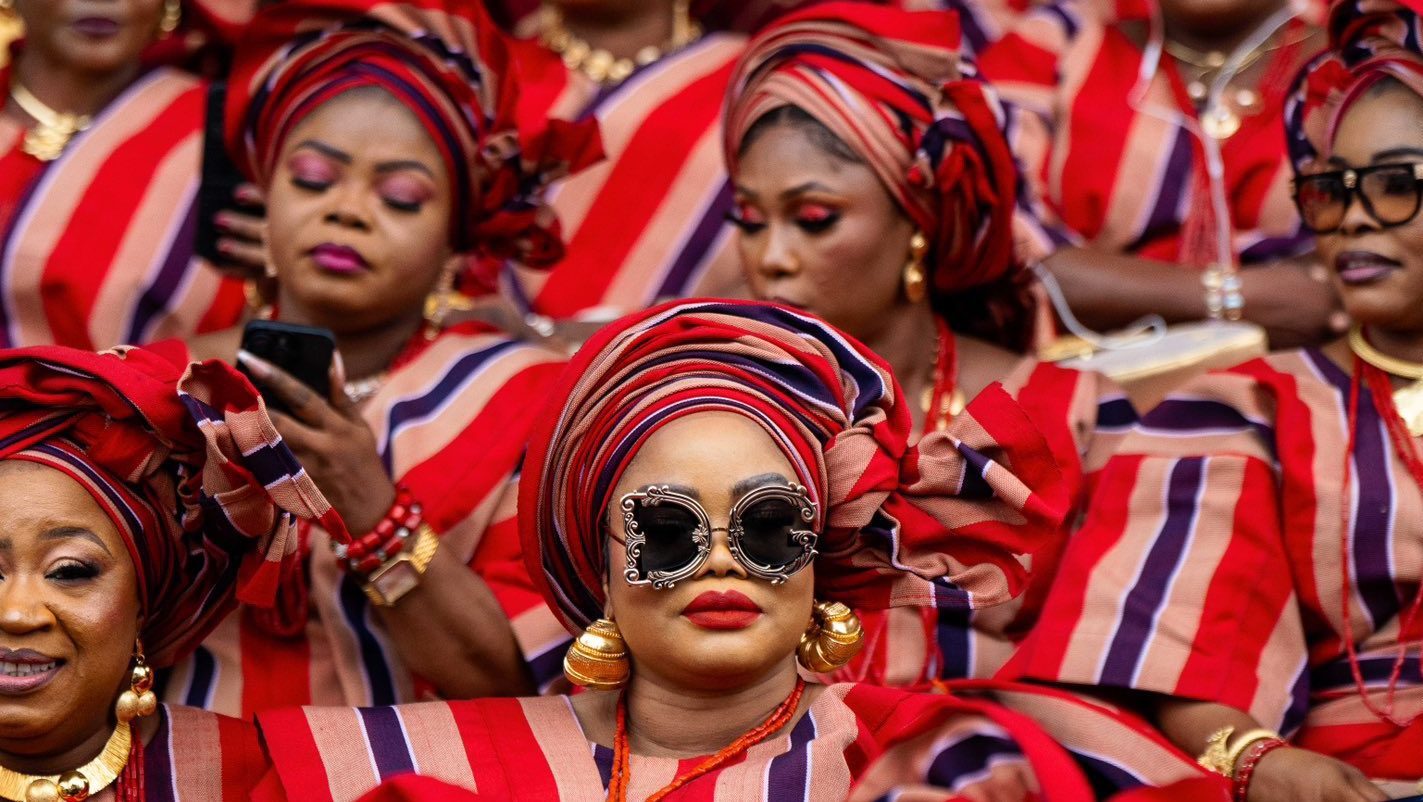
If you’ve seen the photos, you’ve noticed the coordination. Not just matched fabrics, but entire groups, sometimes dozens of people, dressed in precisely the same colours, the same textures, the same silhouettes. That is the regberegbe at work.
At the heart of Ojude Oba lies the parade of age-grade groups known as Regberegbe, social clubs organised by age and gender that have existed for centuries. Every Ijebu person of a certain age belongs, or is expected to belong, to one. The groups appear in coordinated outfits often made from lace, damask, adire, or brocade, sometimes matching down to shoes and jewellery. Each group processes before the Awujale, offers prayers for his long life, and presents gifts. They also report on their community projects for the year, schools built, health initiatives funded, infrastructure contributions made. In recent years, groups often compete for a special sponsor’s prize, appearing in ever more elaborate custom-dyed fabrics, motivated by honour and bragging rights.
The 2026 edition is expected to feature about 90 male and female age-grade groups. Each one a community of peers who’ve known each other since youth, have watched each other marry, mourn, succeed and fail, and who show up every year in formation as a statement: we are still here, still together, still Ijebu. The purpose of the modern regberegbe, as articulated by Oba Adetona himself, is to promote the socio-economic development of Ijebuland, foster fellowship among members, and preserve the cultural heritage of the Ijebu people. Chapters exist as far as the UK and Ireland. The diaspora comes home for this.
The other unmistakable element is the equestrian procession. The descendants of Ijebu War Generals, the Balogun families, arrive on horseback in ceremonial robes, accompanied by trumpets, gun salutes carried out under strict monitoring, and chants. Their equestrian parades, often choreographed to drums and praise chants, embody the martial history of the Ijebu people and serve as a living bridge between past and present. Prominent family names in the procession include Balogun Odunuga, Balogun Kuku, Balogun Alatishe, the Osiboguns, the Foworas, the Adesoyes, the Ajayis, the Oreagbas, the Adesanyas, and the Onanugas, among many others. These are lineages with long memories, families whose ancestors defended the Ijebu kingdom before colonial annexation, and who mark that history every year in full dress and in public.
The Awujale sits on his throne for the full duration of the ceremony. Group after group processes before him. Each one presents itself, their outfits, their achievements, their numbers, and receives his royal blessings in return. The parade is a kind of power dressing, with different groups displaying their glamour and opulence in a kaleidoscope of colour to show off wealth, success, cultural heritage, and the unity and enterprising spirit of the Ijebu. Families commission bespoke pieces months in advance, engaging stylists and tailors to get every detail right. Children walk in velvet slippers and mini geles. The rule among families is unspoken but ironclad: you do not repeat last year’s look. The fabrics are not costumes. They are the language in which these families speak their names.
In 2024, a photograph from the festival went viral. A man named Farooq Oreagba, an Ijebu businessman and cancer survivor, rode in on horseback as part of his family’s procession, dressed with the kind of effortless precision that cameras love. The internet named him King of Steeze. With the fame he got from that moment, attention from around the world became fixated on what the 2025 edition would bring. Celebrities began showing up in numbers: Nollywood actors in full Yoruba traditional attire, street-pop stars making horse-riding entrances to loud cheers. The festival had begun producing its own iconography, its own recurring cast.
With the crowds now including significant numbers of non-indigenes, people who found out about Ojude Oba through a photograph and booked transport to Ijebu-Ode, a familiar tension has surfaced. Should cultural practices be gatekept? Is it an insult or a compliment when outsiders want to participate? Do deviations from traditional dress water down or elevate a culture?
The counter-argument is subtler than a simple yes or no. The regberegbe system is not decorative. It is a social infrastructure. You belong to your group because of when you were born, where you were born, who your people are. When someone attends and stages an elaborate look without that genealogy, what exactly are they celebrating? Can you borrow the aesthetics of a tradition without its grammar?
What is clear is that the festival itself has always been adaptive. It was born from a collision between Islam and indigenous religion. It was formalised and rebranded under a 20th century monarch. When rumours spread in 2026 that the festival might be cancelled following the death of Oba Sikiru Adetona, organisers were quick to debunk them, noting that the Awujale himself had specifically warned that nothing should hinder the celebration, even after his death. The festival transcends any single personality, including the king whose courtyard gives it its name.
The 2026 edition is themed “Celebrating the Legacy of Oba Sikiru Adetona,” paying tribute to the longest-reigning monarch in the kingdom’s history, who died last year at the age of 91 after 65 years on the throne. There is growing advocacy for Ojude Oba’s recognition by UNESCO as part of Nigeria’s intangible cultural heritage. Behind every look is an ecosystem: tailors, weavers, shoemakers, jewellers, makeup artists, photographers, all working overtime. For a few days, Ijebu-Ode becomes the centre of both tradition and commerce.
So is it an aura-farming contest? Partially. Human beings have always used ceremony to announce themselves, to their community, to their monarch, to history. The Ijebu understood this long before Instagram. The regberegbe have been competing in coordinated fabrics for centuries. The Balogun families have been arriving on horseback in their finest for generations. The only thing that changed is the size of the audience.
What matters is whether the audience recognises that the spectacle in the photos is not the festival. The festival is the Awujale on his throne, receiving the 90th group of the day. It is an age-grade of Ijebu elders who have shown up together for fifty years, who stitched their aso-oke from the same bolt of fabric, who remember what this means. The photograph is a door. What matters is whether you walk through it and actually look.