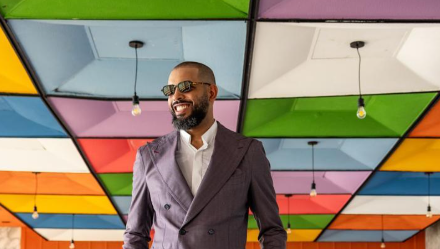
Richard Vedelago, art curator and gallery owner, surprisingly didn’t start out in art. He built his career in real estate and hospitality before he ever picked up a curatorial title, and it shows in the way he talks about culture now, less like a gallerist and more like someone laying infrastructure. Under the Windsor Group, he’s built out real estate, hospitality, luxury retail, art and travel as one interconnected ecosystem, with Windsor Gallery as its fine arts arm, running across Lagos, Abuja and Abidjan.
Then came Nahous, his multidisciplinary cultural hub nestled inside a restored wing of the Federal Palace Hotel, which has become one of the most talked-about spaces in Lagos since it opened. Now, he’s been appointed curator of Nigeria’s pavilion for the 2028 Venice Biennale, tasked with deciding what story Nigeria tells the rest of the world on one of the biggest stages in contemporary art.
We sat down with him to talk about identity, ownership, why he thinks African art needs to stop being priced and sold from the West, and what it actually means to build cultural infrastructure on a continent that’s long been told to export its culture rather than keep it.
You began in real estate and hospitality — you’re a proper businessman. So I’m wondering what drew you to the creative world. Was there a specific moment when you decided that culture was the infrastructure you wanted to build?
I started understanding that culture is probably one of the most important exports we have to redefine our image in Africa. We’ve seen the success of things like Afrobeats and Nollywood as indicators of how we’ve addressed what’s happening on the continent, and the storytelling that comes from Africa. What I really understood was that value wasn’t being created across the full value chain. We were seeing a lot of artists not having the opportunity to optimize and maximize their value and presence, not even in the West, but even in Africa itself. There isn’t a lot of conversation happening across borders culturally, because we’re very insular. My interest was to start building infrastructure to allow Africa to be the primary benefactor of its own culture, to consume it, and to build ways for us to be inspired by one another, because there’s so much interesting work happening across West Africa, across Central Africa, that we’re not privy to.
Speaking of culture, you’re Nigerian-Italian. Two quite different identities. How has that shaped how you see culture, belonging, and space?
I think communication is fundamental. I speak a number of different languages, so how are we communicating what we’re doing in a way that other cultures understand, and can understand the value? That’s been key to understanding how people in Europe present, what their touch points are, and also what we’re trying to achieve and how we tell our stories through things that are more expansive, more open to interpretation, as opposed to always being told what to do.
What languages do you speak?
French, Italian, English. My German isn’t bad. My Spanish isn’t bad. My Portuguese isn’t bad.
The Windsor Group spans energy, real estate, hospitality, luxury retail, and art and travel. How are you holding all of that together? Is there a unifying logic?
It’s the same group of people, really. The people who are interested in real estate or buying properties need interior decoration. People doing interior decoration need access to art. It’s a full value chain, an ecosystem that’s complementary across the board. Our clients are exposed, forward-thinking individuals who are looking for a specific aesthetic or point of view. It’s all interconnected into the broader conversation of what contemporary living looks like today in Africa, and how a contemporary individual creates and puts together structures that correspond to their interests.
You’ve been appointed to lead Nigeria’s curatorial vision for the Venice Biennale in 2028. What does that mean to you, and what would you like Nigeria’s room to say to the world on that stage?
It’s a massive honor to represent Nigeria in any capacity. Being a representative of this great country is something really close to my heart, something I take with great pride. Today the conversation is about ownership. We’re going to show the rest of the world that we’re taking full control of our narrative, our culture, our identity. We’re going to be unapologetic about it, because we are doing the coolest things on the globe at this moment in time. We are the best in class, not just in Africa, but globally.
That’s a really strong statement to make. You run both Windsor and Nahous, and the vibes they give off are very different. Was that on purpose?
Yes. Nahous is more experimental, more multidisciplinary, it has more of a focus across multiple disciplines that sit within the creative sector: fashion, art, photography, design, and gastronomy. Those are the key anchor points that converge under one space, driven by community programming. We get to have a bit more fun from an experimental point of view, pushing the envelope curatorially.
Windsor is more fine-arts driven, there’s more emphasis on building a fine arts program that allows for presentations by different artists from all around the continent, not just Nigeria-centric. We’ve had artists from the Ivory Coast, Senegal, and Central Africa. We use Windsor as a real window into what’s happening in the contemporary art scene in Africa.
You mentioned finance, and I was going to ask a question about money. With Windsor, all the countries you mentioned were African countries. That’s something that’s constant across the board. What does it mean to keep the art, and by extension the money, within Africa? Is that something you’re doing on purpose?
That is exactly what we’re looking to do. Today, the global contemporary art market is worth roughly $1.2 billion in annual sales for African contemporary art, and 70 to 80% of that is still coming from the West. That means pricing, valuation, and demand are still being set from the West, and we’re not taking advantage of any value creation happening across the board. By keeping the artists, exhibitions, and infrastructure on the continent, we’re able to give more artists opportunities to showcase their work, and we’re able to get more collectors to engage.
We’re not going to be able to build capital value as Africans if our best artists are exported internationally. If there’s an artist in Lagos and a collector in Lagos, but the artwork can only be bought in New York, it’s going to be a lot more difficult to buy the work. We need to keep these artists on the continent, build the infrastructure to support them, and give African buyers the opportunity to engage with the work.
The gallery has worked with bodies like the Loewe Foundation, the Macallan, UN Human Rights, and Nigeria’s own National Council for Arts and Culture. Is there usually tension between having institutional partners and retaining your independent curatorial voice?
No, no, no. I’m pretty straightforward with all the institutions I work with, in the sense that they understand what we’re trying to achieve. They trust our vision and our point of view, otherwise, there wouldn’t be that synergy. A lot of the work we do is about introspection, allowing people to create their own points of view and independent thinking. It’s never about pushing a narrative or a message. It’s about getting people to feel comfortable in spaces where they can create their own thinking.
How do you select artists? Is there something you look for that signals this is the kind of person you want to work with?
It’s always fundamentally based on the body of work the artist has created, because that’s what lets me thematically build out the real conversation. They say the best form of art is conversation, and that’s what we always try to do through the body of work. The artists are conduits of conversation, and we always push conversation as the highest point of view we’re trying to create.
Not so long ago, there was Slawn’s ‘Bobo’ exhibition at Nahous, described as a “full circle homecoming.” What do you see as your responsibility when a diaspora artist comes home?
It’s about helping them navigate the landscape, understand the reality on the ground, and create that connection between them and home. We’re essentially conduits, the most important thing I can do is help them understand the landscape, the tempo, the narratives, the energy at this moment, and then help ensure their projects have a specific outcome they’re always trying to achieve. Whether it’s been a Slawn show, a Soldier show, or any of the other artists we’ve represented, we’ve always looked to amplify their artistic point of view through the curatorial approach we’ve taken.
I heard — please confirm if this is right — that it took only four months to transform the Nahous space from the empty space that had been lying there for years. Is that right?
More like three months.
Three? That’s fast. On the first day you stepped inside, what did you see that made you think, “This is the place for me?”
History, space, beauty. There’s always beauty in seeing an unfinished space, because you can also see the ultimate end goal, what your vision represents. It was just a beautiful convergence of energy meets vision meets opportunity. Federal Palace is such a historic site; that building was where FESTAC ’77 was held. So it has so much history to be unraveled and brought back.
Speaking of the history, I think I also heard that Nigeria’s independence declaration was signed at Federal Palace as well.
Correct. Yes, that was signed, before we had the Tafawa Balewa Square declaration, it was signed at the Federal Palace.
It’s kind of remarkable that the building is still standing, since we don’t have the best maintenance culture.
We certainly do not.
So this history feeds into what you do at Nahous, if I’m not mistaken, you try to preserve it.
We try to amplify it.
Visitors describe Nahous as feeling like “stepping into the past and the future at once.” Was that duality of time something you designed, or did the building itself demand it?
A bit of both. The building carries history within its walls. It has witnessed decades of Lagos life, and there is a responsibility that comes with occupying a space like that. Rather than erase its past, we wanted to engage with it. At the same time, Nahous is deeply future-facing. It is about imagining what a contemporary African cultural institution can look like. The result is a dialogue between memory and possibility. Visitors feel that tension because it is real. The building reminds us where we have come from, while the programming asks where we are going.
Nahous hosts exhibitions, talks, residencies, masterclasses, a book club, a concept store stocking only Nigerian designs, a furniture showroom, and a bar. What is the theory of why all of these things need to be in the same room?
Because culture does not exist in silos. Art influences design. Design influences fashion. Fashion influences architecture. Conversation influences creativity. Too often, we compartmentalize these disciplines when in reality they are constantly speaking to one another. Nahous is built around the belief that creativity thrives through collision. Someone may come for a drink and leave having discovered an artist. Someone may come for an exhibition and end up buying a locally designed object. The goal is to create an ecosystem rather than a venue.
The concept store carries only Nigerian designs and products. Do you think that will ever change?
For now, no. The decision is intentional. Nigerian designers, makers and creative entrepreneurs produce extraordinary work, yet they are often underrepresented in their own market. Nahous exists to create visibility and opportunities for local talent. That does not mean we are closed to dialogue with the rest of the world, but our starting point is very clear: we want to champion Nigerian creativity first.
Lagos has extraordinary creative energy, but you’ve said it lacks permanent, multidisciplinary platforms. Why hasn’t this existed before?
The challenge has largely been structural. Spaces like these are expensive to build and difficult to sustain. Real estate costs are high, public funding is limited, and private investment in culture is still developing. Historically, many creative projects have been event-driven rather than institution-driven. People build festivals, exhibitions and activations, but fewer people build permanent cultural infrastructure. What Lagos has never lacked is talent. What it has lacked are long-term platforms capable of supporting that talent consistently.
What does Nahous need from Lagos for it to sustain? What does sustainability look like?
Sustainability is not simply financial. Financially, we need patrons, collectors, corporate partners and audiences who understand the value of investing in culture. Politically, we need policies that recognize creative industries as serious contributors to economic growth and urban development. Socially, we need people to feel ownership of the space. Success is not measured by survival alone. Sustainability means Nahous becomes part of the city’s cultural fabric and remains relevant twenty years from now.
Many Nigerians feel like art is only for a specific type of person. What specifically makes people feel like art isn’t for them, and is Nahous trying to change that?
For decades, galleries have often felt intimidating. There are invisible barriers: language, pricing, architecture, social expectations. Many people assume they need prior knowledge before they can enter the conversation. The truth is that art belongs to everyone. At Nahous, we intentionally blur those boundaries. Someone can come for a book club, a concert, a talk, a meal or a drink and encounter art naturally. Accessibility begins by making people feel welcome. If someone leaves feeling curious rather than intimidated, we’ve succeeded.
Where do you draw the line between accessibility and compromise? Can a space be genuinely open while also selling work at fair market rates?
Absolutely. Accessibility should never mean undervaluing artists. The solution is not to make art cheaper; it is to create multiple entry points into the cultural experience. Not everyone will buy a painting, but everyone can attend a talk, engage with an exhibition or participate in programming. A healthy ecosystem respects both the audience and the artist. The goal is inclusion without dilution.
What’s the one thing a first-time visitor to Nahous or Windsor should leave having felt or learnt?
That culture is not something that belongs to other people. It belongs to them, too. Whether they leave inspired, challenged, informed or simply curious, I want them to feel that they are part of the story.
Your forthcoming book, Lagos Rhythm, uses architecture, ethnography and photography to capture the city. What story about Lagos hasn’t been told yet?
Too many narratives about Lagos focus on extremes: the chaos, the traffic, the scale, the struggle. What fascinates me are the systems beneath the surface. The rituals, the communities, the architecture of everyday life, and the ingenuity that allows the city to function. Lagos is one of the most complex urban environments in the world, but it is also deeply human. A book allows the space to explore those layers with nuance and depth that shorter formats cannot.
The African Contemporary Art Fair, The Garden by L’Epicure, Windsor, Nahous, Venice Biennale 2028; you are building a lot simultaneously. What is the single thread that runs through all of it?
The creation of platforms. Whether it is an art fair, a restaurant, a gallery, a cultural hub or an international pavilion, the objective remains the same: creating spaces where African creativity can be seen, experienced, supported and celebrated. The projects may look different, but they are all part of the same ecosystem.
What’s the one thing you think is most essential for an aspiring curator to know?
Curating is not about objects; it is about people. The best curators understand artists, audiences, communities and context. You are not simply selecting works. You are creating conversations, building connections and shaping how people experience culture. Curiosity and empathy matter far more than expertise alone.